Reproducible Analytics
Workflows that work every time — Quarto, R Markdown, and version-controlled analytics pipelines.
Explore our capabilities, tools, and approach.

Key capabilities
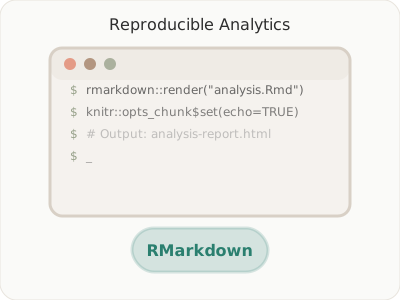
Quarto & R Markdown
Executable documents that combine code, output, and narrative
Version-Controlled Workflows
Git-based reproducibility for every analysis and report
Automated Reporting
Scheduled, automated report generation from raw data to publication
Reproducible analytics build trust.
When your analysis can be re-run by anyone, at any time, with the same results — that’s when data becomes a true asset. We help organisations build transparent, version-controlled analytics workflows using Quarto, R Markdown, and modern DevOps practices.
Why It Matters for Data-Driven Businesses
Reproducibility is the foundation of credible analytics. Without it, organisations face hidden risks: analyses that can’t be audited, reports that can’t be regenerated, and insights that depend on individual memory rather than documented processes. When a key analyst leaves or a reviewer asks to see the underlying work, the absence of reproducibility becomes an organisational liability.
The costs of non-reproducible analytics are both direct and indirect. Direct costs include rework — recreating analyses from incomplete notes, rebuilding reports from scratch, or spending hours verifying results that should be self-evident from a reproducible pipeline. Indirect costs include lost trust when stakeholders can’t verify findings, delayed decisions when results need manual reconfirmation, and compliance risks in regulated environments where audit trails are mandatory.
In health, government, and research — sectors we serve regularly — reproducibility isn’t optional. Peer review, regulatory submission, and public accountability all demand that analytical results can be independently verified. But even in commercial settings, reproducibility delivers tangible value: faster onboarding for new team members, fewer errors in report production, and the confidence that comes from knowing your insights are built on documented, testable processes.
Our Capabilities
Reproducibility isn’t just a technical requirement — it’s a quality standard. We design workflows where every analysis, report, and insight can be traced back to its source data and executed from scratch with predictable results.
This means fewer errors, faster audits, easier onboarding for new team members, and confidence that your insights hold up under scrutiny.
We use Quarto as the primary tool for reproducible documents. Quarto extends the R Markdown format with support for multiple output formats (HTML, PDF, Word, PowerPoint), cross-references, citations, and computational engines beyond R. Quarto documents combine narrative text, executable code blocks, and generated outputs into a single source file that renders into a polished report with one command. This eliminates the copy-paste workflow that produces inconsistencies between code output and report text.
Git version control tracks every change to analyses, reports, and code. Combined with meaningful commit messages and branching strategies, Git provides a complete history of how analyses evolved — who changed what, when, and why. This isn’t just about code backup; it’s about creating an auditable record of analytical decisions.
GitHub Actions enables automated report generation. We set up CI/CD pipelines that trigger report renders on a schedule, when data is updated, or when code changes are pushed. This means reports are always up to date without manual intervention — a weekly dashboard renders itself every Monday morning, a monthly compliance report generates on the first business day, and ad-hoc analysis notebooks auto-render when analysts commit changes.
Docker containers ensure that the computational environment — R version, package versions, system dependencies — is identical across developer machines, review environments, and production execution. This eliminates the “it works on my machine” problem that undermines reproducibility in multi-person teams.
We also implement automated testing within analytical pipelines using packages like testthat, ensuring that data quality checks, statistical calculations, and report rendering logic are validated before outputs are distributed.
Driving Decision-Making
Reproducible workflows change how organisations make decisions about data. When every report is generated from a version-controlled pipeline, decision-makers can trust that the numbers they’re seeing are the result of a documented, tested process — not the output of an ad-hoc spreadsheet that can’t be traced.
We structure reproducible workflows to support different decision rhythms. Operational teams get daily or weekly automated dashboards that surface current metrics and flag anomalies. Strategic decision-makers receive monthly or quarterly reports with trend analysis, contextual commentary, and forward-looking indicators. Each output is generated from the same underlying codebase, ensuring consistency across reporting cadences.
The reproducibility pipeline also enables faster response to decision-maker questions. When a leader asks “what if we change this assumption?” or “can you break this down by region?”, a reproducible analysis can be modified and re-rendered in minutes rather than hours — the code is documented, the data pipeline is automated, and the output regenerates automatically.
Influence and Engagement
Reproducible analytics strengthen an organisation’s credibility with external stakeholders. Whether it’s a regulator reviewing submissions, a journal evaluating a manuscript, or a board scrutinising performance reports, the ability to demonstrate exactly how every result was produced builds confidence and accelerates decision-making.
We help organisations build reproducibility cultures through practical engagement. This means showing teams how version control prevents lost work, how automated reports reduce weekend crunch, and how documented analyses make knowledge transfer straightforward when team members rotate or leave. We’ve seen reproducibility initiatives transform team dynamics — reducing hero-culture dependencies, enabling parallel collaboration, and creating a foundation of shared analytical standards.
Our approach to change management recognises that reproducibility can feel like overhead until teams experience its benefits. We start with quick wins — automating one painful report, setting up version control for one critical analysis — and let the time savings and error reductions speak for themselves before expanding the practice more broadly.
When You Need This Service
- Audit readiness: Producing transparent, traceable analyses that stand up to internal or external review
- Team scaling: Onboarding new analysts who need to understand and extend existing work without starting from zero
- Regulatory compliance: Meeting standards that require documented, repeatable analytical processes
- Report automation: Replacing manual report production with scheduled, automated workflows that reduce human error
- Collaborative projects: Multi-person analyses where version control and clear documentation prevent confusion and duplication
What to Expect
We start by auditing your current workflows and identifying reproducibility gaps. From there, we redesign your processes around executable documents, version control, and automation. Deliverables include migrated analyses, updated documentation, and — where applicable — CI/CD pipelines that automate report generation on a schedule or trigger.
Tools & technologies
Industries we serve
- Health & Medical
- Government & Public Sector
- Research & Academia
- Finance & Insurance